
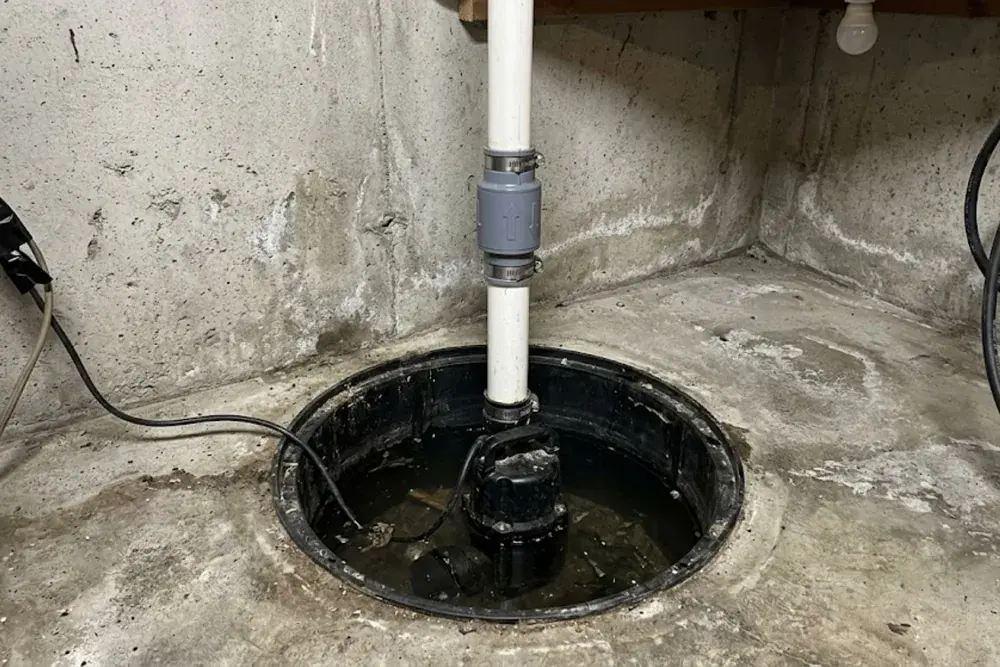
Why submersible
A submersible pump sits underwater in the pit, so it runs quietly and the water keeps its motor cool. A pedestal pump keeps its motor above the pit and is louder and shorter lived.
For a home that relies on its pump during storms, the submersible is the usual choice.
Before the install
Questions we answer first
- Is there an existing pit, or does one need to be dug?
- How much water comes in during a heavy storm?
- Where will the discharge go, and how far?
- Is there a dedicated outlet on a protected circuit?
- Do you want a battery backup?
The pit should be deep enough to hold water between pump cycles and wide enough for the float to move freely. A pit that is too small makes the pump short cycle and burn out.
The discharge line must run away from the foundation and not toward a neighbor. We check the slope and the frost protection on the line.
Installation steps
Prepare the pit
Clear the pit, check the depth and place a bed of gravel at the bottom.
Set the pump
Place the pump on a firm base so it stands level and the float moves freely.
Install the check valve
Fit a check valve on the discharge so water does not run back into the pit.
Run the discharge
Pipe the water outside and away from the foundation with a slight slope.
Wire and test
Plug into a protected outlet, pour water in and confirm the pump starts and shuts off.
| Part | Job | Common mistake |
|---|---|---|
| Check valve | Stops backflow | Left out, so the pump cycles constantly. |
| Weep hole | Prevents airlock | Not drilled in the discharge pipe. |
| Float switch | Starts and stops the pump | Stuck against the pit wall. |
| Discharge pipe | Moves water outside | Ends too close to the house. |
Battery backup
Storms often cut the power, which stops the primary pump when it is needed most. A battery backup pump sits beside the main pump and runs on a battery when the power fails.
Test the battery every few months and replace it as the maker recommends. A backup that has not been tested is not a backup.
Pumps and the Pleasantville water table
Pleasantville sits at about seven feet above sea level, and the city's flood information describes tidal and creek flooding in several areas. In low areas the water table rises after heavy rain, which makes a dependable pump and a backup more important.
Ask the construction official whether your lot is in a flood zone, and tell us when you call. We plan the pit and the discharge for the worst-case storm, not an average day.
Cost factors
The price depends on whether a pit exists, the pump size, the discharge length and the backup. We give a clear price before work starts, and we explain what each part adds.
Our sump pump installation and repair page covers the visit, and basement waterproofing covers drainage.
Maintenance
Each season, lift the float and confirm the pump runs, and check the discharge for ice or blockage. Clean silt out of the pit once a year.
A pump that is more than about ten years old is a candidate for replacement. Do not wait for it to fail in a storm.
Choosing pump power
Most homes use a third to half horsepower pump. A larger pump moves more water, but it also short cycles in a small pit.
Choose based on the volume of water and the height it must lift. We calculate the head from the pit to the discharge point.
Electrical safety
Sump pumps should plug into a ground-fault protected outlet, and the circuit should not be shared with a heavy appliance. A tripped breaker during a storm shuts down the pump.
Never run extension cords through standing water. If the panel is in a wet area, call an electrician and your utility.
Discharge in winter
Discharge lines can freeze or clog with ice. A freeze-protection fitting or a short, sloped run to open ground helps.
Check the end of the line after hard freezes. A frozen discharge makes the pump run without moving water.
Signs your current pump is failing
Warning signs
- The pump runs constantly or cycles every few seconds.
- It makes grinding, rattling or humming noises.
- The float sticks or the pump will not start.
- Rust, corrosion or silt coats the pump.
- The pump is older than ten years.
Planning for a storm
Before a forecast storm, test the pump, clear the pit and check the discharge line. Move valuables off the floor and know where the main valve and breaker panel are.
If water starts to rise and the pump fails, call the 24/7 line. We dispatch quickly when a plumber is available.
Mistakes to avoid
Do not set the pump directly on silt, because debris clogs the inlet. Do not let the float touch the side of the pit, because it will stick. Do not skip the check valve.
Do not tie the discharge into a sewer line. In most places that is not allowed, and it can overload the sewer during a storm.
After the install
Ask for a demonstration. Pour water in the pit, watch the pump cycle and listen for the check valve to close. Keep the paperwork and the warranty.
Set a reminder to test the pump each season. A pump that has sat idle for months may stick when you need it.
What a clear quote includes
A good quote names the pump, the check valve, the discharge pipe and any backup. It states whether the pit work and electrical changes are included.
Ask what the warranty covers and what happens if the pump fails during the first storm. Clear answers up front prevent disputes later.
Pump failed or planning an install? Call the 24/7 line.
Call (609) 547-1417Standards and sources
- Plumbing work in New Jersey is governed by the Uniform Construction Code plumbing subcode (N.J.A.C. 5:23-3.15), which adopts the National Standard Plumbing Code. Your local construction official issues permits and inspects the work.
- Plumbers are licensed by the New Jersey State Board of Examiners of Master Plumbers. You can check a license with the board before work starts.
- Flood damage is a separate matter from a standard homeowner policy. FEMA's National Flood Insurance Program sells flood coverage, and policies typically carry a waiting period.
- Electrical work for outlets, switches and circuits must be done by a licensed electrician.