Is tankless right for your home?
Tankless units suit households that want endless hot water in a smaller footprint. They are less attractive where the gas line is small or the exhaust route is long and awkward.
A key limit is flow rate. A unit sized for two showers will struggle if three fixtures open at once. We size by the number of fixtures you run together, then confirm the gas input matches.
| Requirement | Why it matters | What we check |
|---|---|---|
| Gas supply | The burner draws far more gas than a tank | Meter capacity and the diameter of the line. |
| Venting | Exhaust gases must leave safely | Material, length and termination point per the manufacturer. |
| Condensate drain | Condensing models produce acidic water | A drain path and neutralizer where required. |
| Electric outlet | Controls and fans need power | A nearby outlet on a suitable circuit. |
| Water quality | Minerals coat the heat exchanger | Hardness and a plan for flushing. |
Flush and descale: the maintenance that matters
Mineral scale thickens the inside of the heat exchanger and cuts flow. Symptoms include a unit that cycles on and off, water that stays lukewarm, or an error code that returns after a reset.
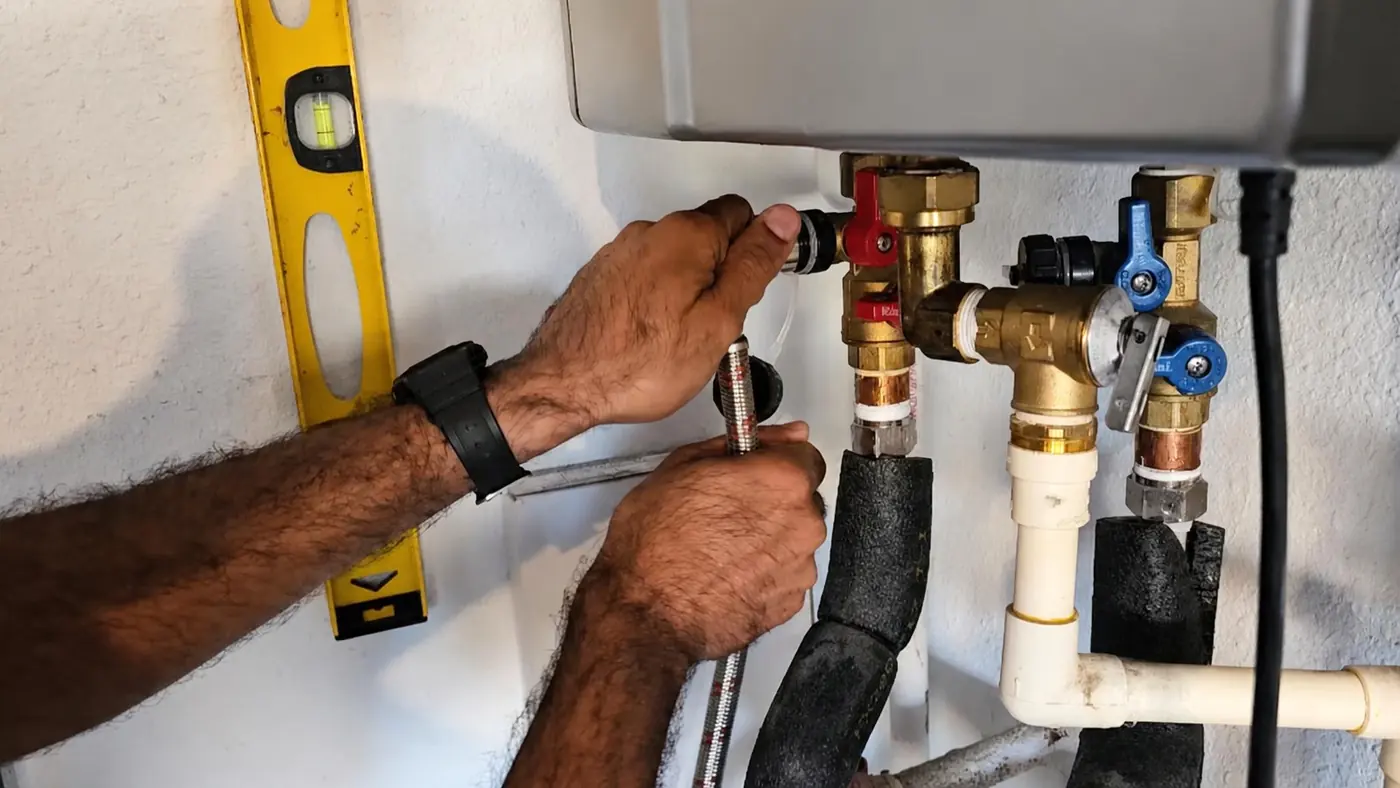
A flush runs descaling solution through the unit with a pump so that deposits dissolve and rinse out. Many manufacturers ask for it yearly, and the interval shortens where water carries more minerals. Ask us which schedule fits your household.
Repairing a unit that will not heat
Error codes point toward a part group, such as ignition, flame sensing, flow sensing or temperature sensing. A code is a starting point, not a diagnosis, so we read the code and then test the part before replacing anything.
Some plumbers will only replace a tankless unit and decline to service it. We repair them when repair makes sense, and we say plainly when the heat exchanger is beyond a sensible repair.
Cold sandwich and the first few seconds
Tankless units take a moment to fire, and a short burst of cold water between two shorter draws is normal behavior. A recirculation line or a small buffer tank reduces it. If you notice persistent lukewarm water instead, see our water heater repair page for the diagnostic steps.
Considering a tankless swap? Call and we will check your gas line and venting first.
Call (609) 547-1417What affects the price of a tankless project
- The unit's capacity and efficiency rating.
- Gas line upgrades and meter capacity.
- Venting material and route length.
- Condensate drain and electrical work.
- Descaling service frequency afterward.
A tankless installation is rarely an insurance claim, but damage from a sudden failure of any heater may be, so photograph the area before cleanup.
We give a clear price before work starts. For your real number, call {p}. Installs from a failed tank are covered under water heater installation.
Standards and sources
- Plumbing work in New Jersey is governed by the Uniform Construction Code plumbing subcode (N.J.A.C. 5:23-3.15), which adopts the National Standard Plumbing Code. Your local construction official issues permits and inspects the work.
- Plumbers are licensed by the New Jersey State Board of Examiners of Master Plumbers. You can check a license with the board before work starts.
- Gas appliances must follow the manufacturer's installation instructions and local code for venting, clearances and combustion air. Burner and gas work belongs with a licensed contractor.
- Electrical work for outlets, switches and circuits must be done by a licensed electrician.