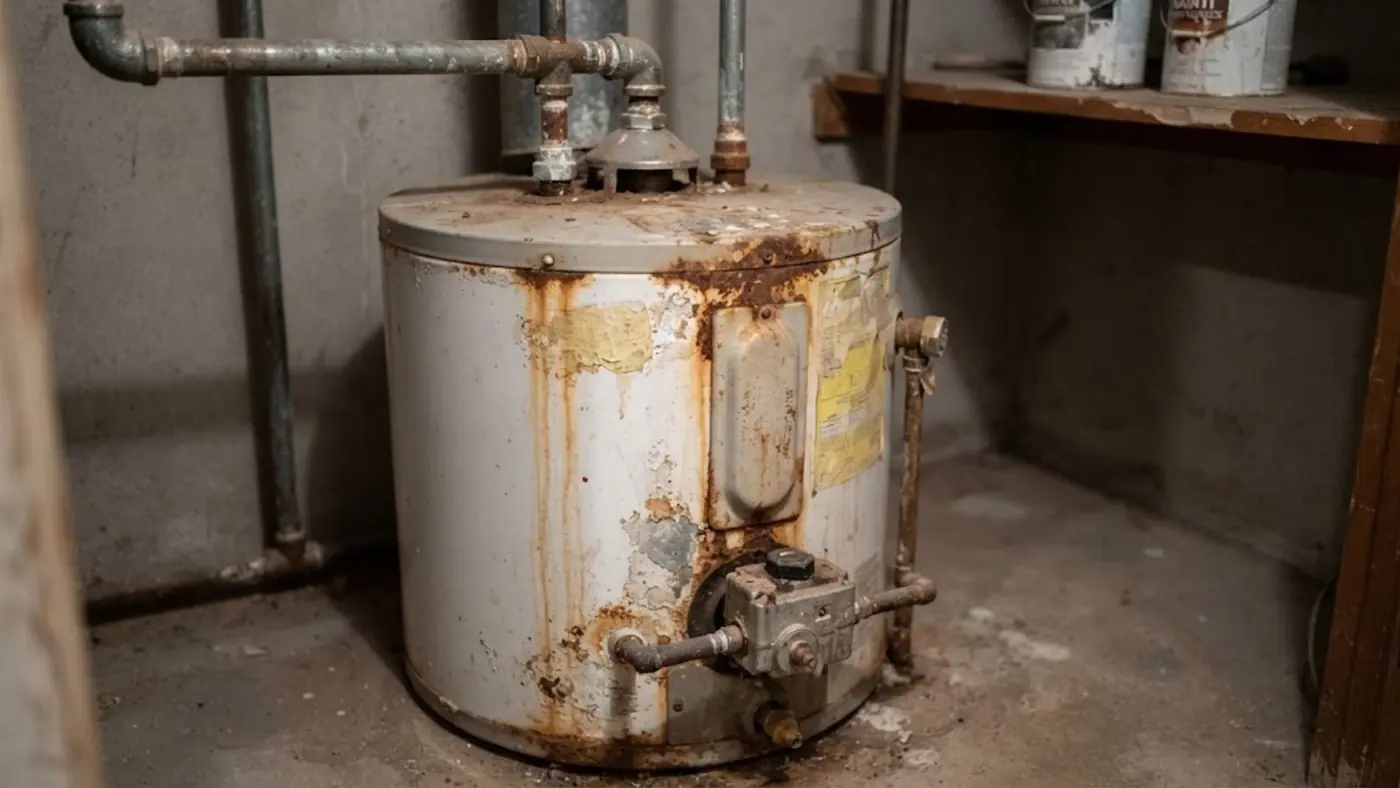
A failed tank: what the emergency looks like
A tank that fails slowly drips from the base. One that fails suddenly can release dozens of gallons within minutes, which is why shutting off the cold supply matters more than finding the leak.
Once the water is stopped, the question becomes how fast you need hot water back. We can often remove the old heater and set the new one on the same day, depending on stock and the home's venting.
Signs the tank is finished
- Water at the base of the tank rather than at a pipe fitting.
- Rust streaks or flaking at the seams of the tank.
- A unit older than about ten years that now needs repeated repairs.
- Rumbling and popping that returns right after a flush.
- Hot water that is rust colored from the tank itself.
Choosing the replacement
Sizing starts with how many people use hot water at the same time, not with the house's square footage. A tank that is too small runs out during back-to-back showers. One that is too large wastes energy keeping extra water hot.
Fuel is the next choice. A gas heater needs a proper vent and a gas line in good order. An electric unit needs the right circuit. Heat pump models need space and drain access. We explain each trade-off before anything is ordered.
| Option | Best for | Trade-off |
|---|---|---|
| Standard gas tank | Homes already piped for gas | Needs a good vent and an annual look at the burner. |
| Standard electric tank | Homes without gas service | Slower recovery than gas in a busy household. |
| Heat pump (hybrid) tank | Households that want lower running cost | Needs open space and a condensate drain. |
| Tankless unit | Households that want endless hot water | Higher upfront cost and annual descaling. |
If you are leaning toward a wall-mounted unit, read our tankless water heater page first, because a switch from tank to tankless changes the gas line, the vent and sometimes the electrical supply.
Code and permits in Pleasantville
Under New Jersey law, plumbing must be performed by a master plumber, an authorized plumbing contractor, or their W-2 employees, as the State Board of Examiners of Master Plumbers states. That is a good reason to check the credentials of anyone quoting a water heater swap.
Permit requirements for a replacement vary, so ask the Pleasantville construction office whether your swap needs one. We can describe what the job involves so the answer is quick.
What to do before we arrive
If the tank is leaking, close the cold water valve above the heater and switch off the gas or the breaker. Never touch a heater that is sitting in standing water with the power on.
Run a hot tap to confirm there is no hot water, then put towels around the base. If you smell gas, leave the house and call the gas utility and 911 before you call us.
Tank leaking now? Call the 24/7 line and ask for a same-day replacement slot.
Call (609) 547-1417What affects the price of replacement
- The unit you pick, including capacity, fuel and efficiency.
- Venting changes, such as a new liner or direct vent.
- Gas line, electrical or drain upgrades.
- Expansion tank and relief valve requirements.
- Removal and haul-away of the old tank.
Insurance may pay for water damage from a sudden tank failure but not for the heater itself. Photograph the area before cleanup.
We give a clear price before work starts. For your real number, call {p}.
Standards and sources
- Plumbing work in New Jersey is governed by the Uniform Construction Code plumbing subcode (N.J.A.C. 5:23-3.15), which adopts the National Standard Plumbing Code. Your local construction official issues permits and inspects the work.
- Plumbers are licensed by the New Jersey State Board of Examiners of Master Plumbers. You can check a license with the board before work starts.
- Gas appliances must follow the manufacturer's installation instructions and local code for venting, clearances and combustion air. Burner and gas work belongs with a licensed contractor.