
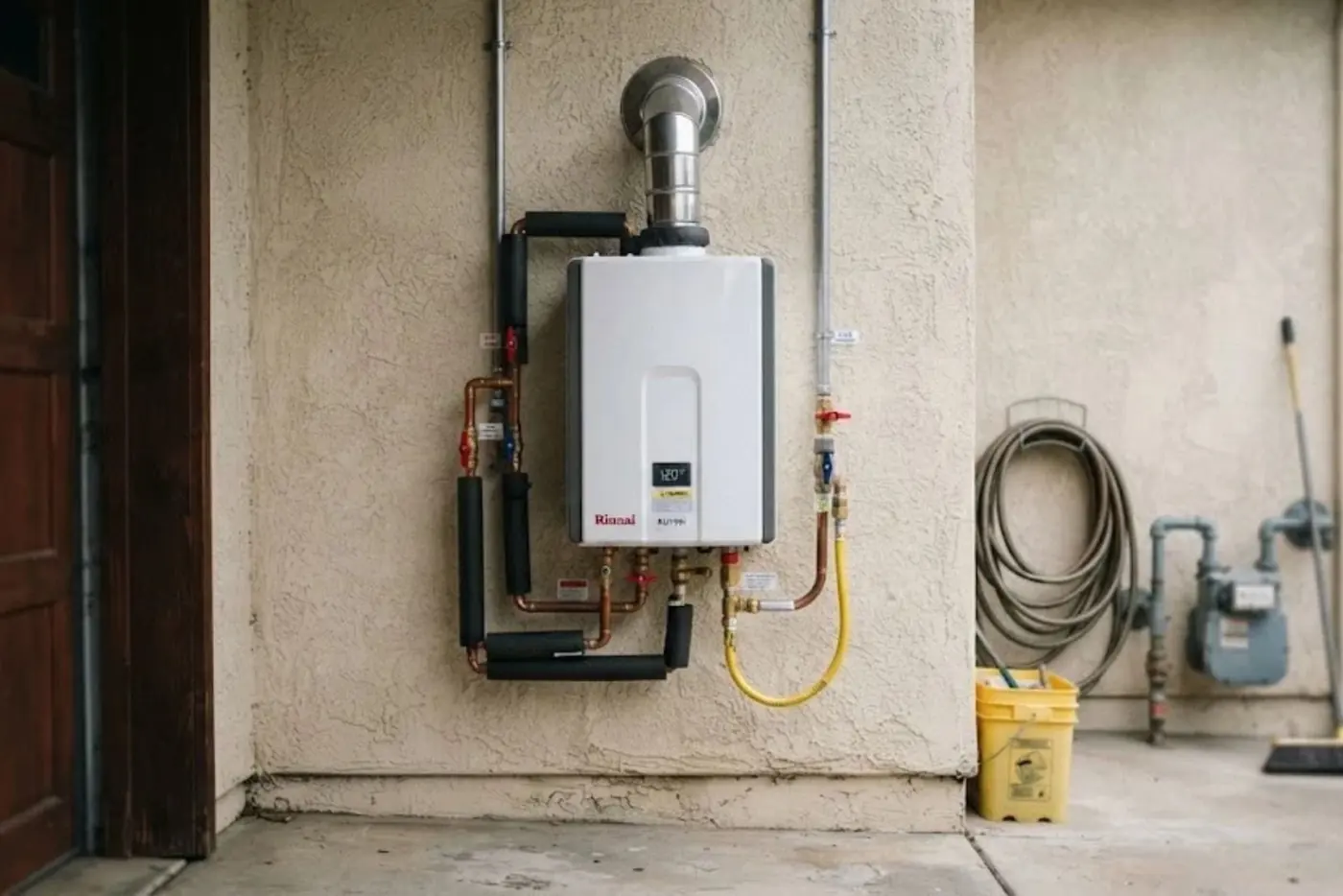
Why the exhaust pipe matters
A gas tankless heater burns fuel and produces exhaust that contains carbon monoxide. The exhaust must leave the house through a sealed path, and any leak puts that gas indoors.
That is why the manufacturer's installation manual sets strict rules for the vent. Following them is a safety requirement, not a suggestion.
Vent materials
| Vent type | Used for | Notes |
|---|---|---|
| Stainless steel | Non-condensing units | Handles higher exhaust temperatures. |
| PVC, CPVC or polypropylene | Condensing units | Only where the manufacturer lists it. |
| Concentric (pipe in a pipe) | Condensing units with sealed combustion | Brings in air and exhausts through one wall hole. |
| Existing chimney | Rarely suitable | Usually must be relined or avoided. |
Never mix vent materials or use a pipe the manual does not list. A pipe that softens at exhaust temperatures can leak, and a leak is a carbon monoxide risk.
Use only the vent parts specified for your model, and seal every joint the way the manual directs.
Length, elbows and slope
Every manufacturer limits the total vent length, and each elbow counts as extra length. A run that is too long or has too many bends restricts the exhaust and trips the unit.
Condensing units also require the pipe to slope back toward the heater so condensate drains instead of pooling in the vent. A pipe that slopes the wrong way fills with water.
What the installer checks on the vent path
- Total length and number of elbows against the manual.
- Slope back to the unit for condensing models.
- Clearance to windows, doors, meters and air intakes.
- Support brackets at the spacing the manual lists.
- Termination height above grade and snow.
- Distance from the neighbor's property and walkways.
Where the vent ends
The exhaust terminal must sit at a safe distance from windows, doors and fresh air intakes, and above the height snow or flood water may reach. A terminal too close to a window can push exhaust into a bedroom.
Under New Jersey codes the local inspector confirms the termination. We confirm it again before we leave.
Carbon monoxide alarms
Install a working carbon monoxide alarm near the sleeping areas and near the heater. If it sounds, leave the house and call 911. Do not wait to see if it stops.
Common vent mistakes
The most common mistakes are the wrong pipe material, an unsupported long run, a pipe that does not slope and a terminal too close to a window. Each one can be avoided with a plan before installation.
If you buy a unit online and hire someone to hang it, ask them to read the manual with you before they start. A good installer welcomes the question.
Vent heights and Pleasantville flooding
The City of Pleasantville's flood information describes tidal flooding on its eastern and northern edges and flooding from Conovers Creek in the north. If your home is in or near those areas, place the vent terminal and the unit above the expected water level.
Ask the building department for the flood zone and base flood elevation on your property, and tell us when you call. We plan the vent height around that figure.
How tankless vent differs from a tank heater
A standard tank heater usually vents through a chimney or a draft hood. A tankless unit is a different design, and it needs its own vent.
If you are replacing a tank with a tankless unit, the old chimney vent often cannot be reused. See tankless water heater and water heater installation for how we plan the work.
What to do if the unit shows a vent error
Many units display an error code when the exhaust is blocked or the vent is too restricted. Do not reset it repeatedly. Turn the unit off and call.
Check outside for snow, leaves or a bird nest on the terminal. Clear nothing near a hot exhaust unless the unit is off and cool.
Inspecting an existing vent
If you already have a tankless unit, look at the vent from time to time. Check for loose joints, sagging pipe, staining at seams and any corrosion at the terminal.
If you see soot or a stain, turn the unit off and call. Do not tape over a leaking joint and keep running it.
Winter and exhaust terminals
Snow and ice can block a terminal. Keep the area clear after storms and check that nothing is stacked against the wall near the vent.
A blocked terminal causes error codes, and a unit that shuts down on a cold night is an emergency call.
Questions to ask before you install
Ask your installer
- Which vent material does the manual require for this model?
- What is the maximum vent length, and what is mine?
- Where will the terminal sit, and how far from windows?
- How will condensate drain?
- Who confirms the installation with the local inspector?
When to replace an old vent
Vent pipe that is cracked, discolored or sagging should be replaced, not patched. Corrosion on a stainless vent or a soft spot on plastic means the pipe has reached the end of its life.
If you plan to upgrade the heater, replace the vent at the same time. A new unit on an old vent is a risk.
Why we read the manual on every job
Each model has its own vent rules, and manufacturers update them. What worked on the last install may not apply to the next unit.
We keep the manual at the job and check each rule against the actual run. That habit catches problems before they reach the inspector.
Keep the manual and the paperwork
Store the installation manual, the permit and the inspection record with your house papers. They matter if you sell or file a warranty claim.
Write down the vent length and the terminal location. A future plumber can read it in a minute and avoid guessing.
Tankless unit with a vent error or a new install? Call the 24/7 line.
Call (609) 547-1417Standards and sources
- Plumbing work in New Jersey is governed by the Uniform Construction Code plumbing subcode (N.J.A.C. 5:23-3.15), which adopts the National Standard Plumbing Code. Your local construction official issues permits and inspects the work.
- Plumbers are licensed by the New Jersey State Board of Examiners of Master Plumbers. You can check a license with the board before work starts.
- Gas appliances must follow the manufacturer's installation instructions and local code for venting, clearances and combustion air. Burner and gas work belongs with a licensed contractor.
- Electrical work for outlets, switches and circuits must be done by a licensed electrician.