Gas supply and pipe size
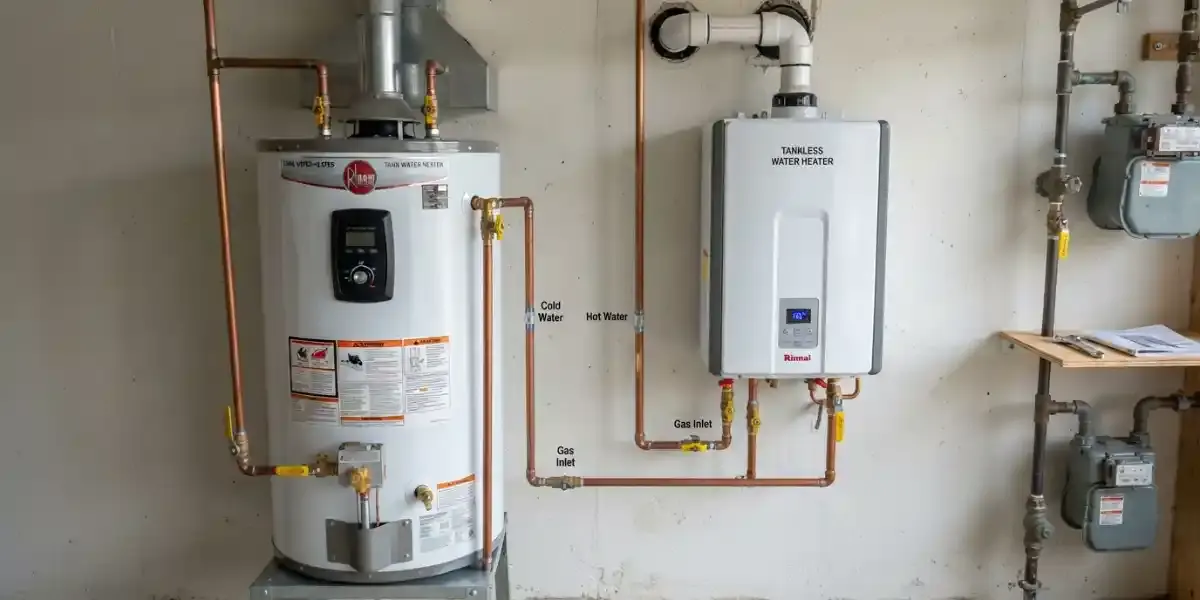
Gas tankless units draw far more gas at once than a tank heater. A line sized for a tank may be too small, and a house with an old half-inch gas pipe often needs an upgrade.
The installer calculates the total load of all appliances on the line and the pipe length. An undersized line causes the unit to shut down or deliver weak hot water.
Venting
Tankless units vent through sealed plastic or stainless pipe, depending on the model. The manufacturer sets the maximum length, the number of elbows and the clearance to windows and meters.
If the unit is on an interior wall, the vent has to reach outside. That can mean going through a wall, a roof or a floor, and the route affects the cost.
| Item | Why it matters | Common issue |
|---|---|---|
| Gas line size | Burner needs a high flow | Pipe too small for the load. |
| Vent path | Exhaust must exit safely | Long run or too many elbows. |
| Electric outlet | Fan and controls need power | No outlet near the unit. |
| Condensate drain | Condensing units make acidic water | No drain nearby. |
| Water pressure | Flow sensors need enough pressure | Low pressure or sediment. |
| Wall space | Unit and service clearances | Tight closet. |
Electricity and condensate
Even a gas tankless heater needs power for its fan, controls and ignition. A nearby outlet on a proper circuit is part of the plan.
Condensing models produce acidic condensate that must drain safely. A floor drain, a laundry standpipe or a neutralizer and pump handles it, and code or the manufacturer may specify which.
Water quality and the isolation valves
Minerals build up inside a tankless heat exchanger, and the unit performs best when its valves let you flush it. Install service valves on the water lines so a plumber can flush the unit each year.
Skipping the valves is a false saving. A unit that cannot be flushed loses output as it scales.
Permits and paperwork
- A plumbing permit from the local building department.
- A gas inspection where required.
- Manufacturer instructions kept for the inspector.
- A written warranty with installation date and serial number.
Pleasantville requirements and water
New Jersey American Water's Atlantic system supplies Pleasantville from groundwater wells, and its 2022 report did not list hardness. Because mineral buildup can affect a tankless unit, ask us to test your water at the visit and plan flush intervals.
Flood information from the city describes tidal and creek flooding in parts of town, so mount the unit above any known flood elevation and tell us if your basement has flooded before. Ask the building department which permits your job needs.
Costs and when it makes sense
A tankless install costs more than a tank swap because of gas, venting and sometimes electrical work. The benefits are continuous hot water and a unit that takes little space.
If your house already has the right gas line and vent path, the cost drops. If it needs a new vent through a finished wall, the cost rises. See tankless water heater for service and water heater installation for planning.
Questions to ask your installer
Ask for the load calculation, the vent route and the permit plan in writing. A good installer answers clearly and explains what could change after the walls are opened.
Ask also who services the unit afterward and how often it should be flushed.
Sizing a tankless unit
A tankless unit is rated by how many gallons per minute it can heat at a certain temperature rise. In cold months, the incoming water is colder, so the unit delivers less flow than in summer.
Add up the fixtures you might run together. A shower and a dishwasher at once need more flow than a shower alone, and an undersized unit disappoints.
The plumbing around the unit
A tankless unit installs with isolation valves, a pressure relief where required and a connection to the recirculation line if you have one. Some homes need a small buffer tank for low-flow fixtures.
If your house has long pipe runs, a recirculation pump keeps hot water close to the fixtures. Without it, you wait while cold water clears.
Common surprises after the wall is opened
Old gas lines may be undersized, old vents may be damaged, and an outlet may sit on a shared circuit. Each of these can add to the plan.
A good installer tells you about them before work starts and again if something new appears. Ask for changes in writing.
Maintenance schedule after installation
Plan a yearly flush to remove scale, and keep a record of the date. Clean the inlet screen and check the vent and the condensate drain at the same visit.
A tankless unit that is cared for lasts many years. One that is ignored loses output and eventually fails early.
Comparing a tankless upgrade to a tank swap
A tank swap is faster and cheaper up front, and it needs few changes. A tankless unit costs more to install and may need gas, vent and electrical work, but it saves space and delivers continuous hot water.
If your family uses a lot of hot water at once, a tankless unit may suit you. If you want the simplest path after a failure, a tank gets you running fast.
Preparing your house for the installer
Clear the area around the old heater and the planned location. Know where the gas shutoff and the main water valve are, and tell the installer about any past leaks.
Plan for the water to be off for part of the day. A clear plan shortens the visit and avoids surprises.
Warranty basics
Tankless units often carry separate warranties for the heat exchanger and the parts. Labor may be covered for a shorter time or not at all.
Read the terms before you buy and ask whether yearly flushing is required to keep the warranty valid.
Planning a tankless install? Call the 24/7 line to schedule a visit.
Call (609) 547-1417Standards and sources
- Plumbing work in New Jersey is governed by the Uniform Construction Code plumbing subcode (N.J.A.C. 5:23-3.15), which adopts the National Standard Plumbing Code. Your local construction official issues permits and inspects the work.
- Plumbers are licensed by the New Jersey State Board of Examiners of Master Plumbers. You can check a license with the board before work starts.
- Gas appliances must follow the manufacturer's installation instructions and local code for venting, clearances and combustion air. Burner and gas work belongs with a licensed contractor.
- Electrical work for outlets, switches and circuits must be done by a licensed electrician.