Two valves, two different jobs
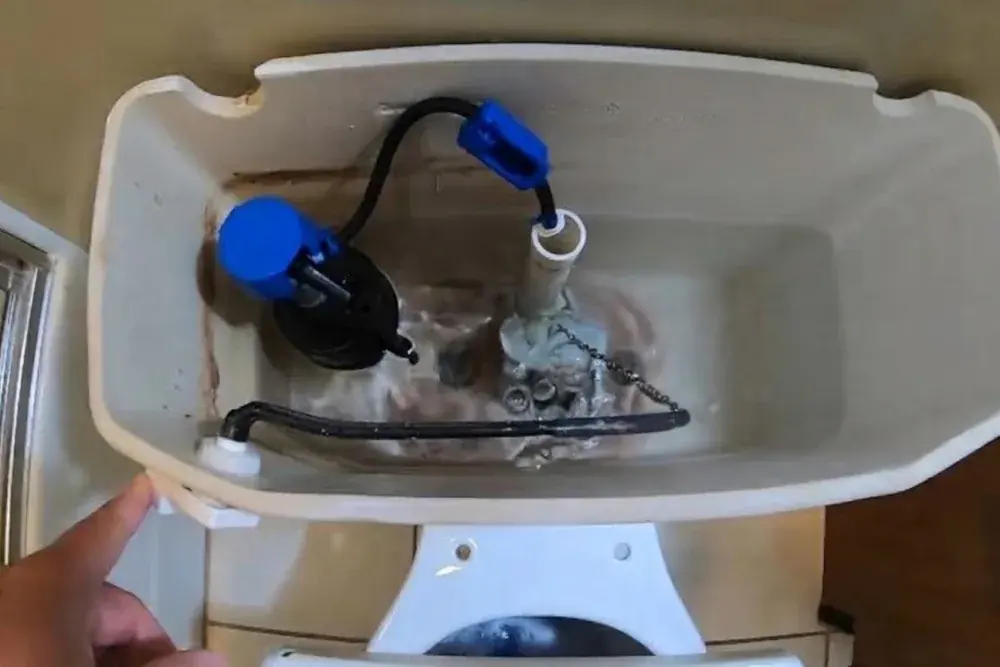
A toilet has two valves that people confuse. The shutoff valve, often called the angle stop, sits on the wall or floor and lets you stop the supply. The fill valve sits inside the tank and refills it after each flush.
Knowing which one is failing tells you whether the repair is a ten-minute swap or a plumbing call. A leak at the wall points to the shutoff valve, and a constant hiss from the tank points to the fill valve.
Signs the fill valve has failed
What a failing fill valve does
- A hissing or trickling sound after the tank looks full.
- Water running into the overflow tube.
- A tank that refills slowly or not at all.
- A toilet that cycles on its own every few minutes.
- A water bill that creeps up with no other cause.
Lift the tank lid and watch the water level. If it rises past the line marked on the tank or over the top of the overflow tube, the fill valve is not shutting off.
Most fill valves can be replaced without removing the tank. You close the supply, flush to empty the tank, disconnect the supply line, swap the valve and reconnect, then set the water level to the manufacturer's mark.
When the shutoff valve is the problem
A shutoff valve fails in two ways. It leaks around the stem or at the supply line connection, or it will not close fully because the internal washer has hardened. Both show up when you need them most.
Never force a stiff valve. Old stems can snap and release water at full pressure. If a shutoff will not turn, close the main valve for the house and call us, because replacing the stop is a short job for a plumber and a messy one for an unprepared homeowner.
| What you see | Likely cause | Typical fix |
|---|---|---|
| Hissing from the tank | Failed fill valve or worn seal | Replace the fill valve. |
| Water over the overflow tube | Float set too high or valve failing | Adjust the float, then replace if it persists. |
| Drip at the wall valve | Worn packing or loose nut | Tighten gently, or replace the shutoff. |
| Valve will not close | Hardened internal washer | Close the main, replace the shutoff. |
| Puddle at the base of the toilet | Failed wax ring, not a valve | Toilet repair with a reset. |
What to do while you wait for a plumber
Close the shutoff
Turn the wall valve clockwise until snug. If it will not close, close the main valve.
Lift the tank lid
Push the flapper down to stop the fill if water is overflowing.
Dry the floor
Use towels so water does not reach the subfloor or baseboards.
Check below
If the toilet is upstairs, look at the ceiling underneath for stains.
Call the 24/7 line
Tell us what you heard and what you shut off.
Repair or replace the toilet
Valves are cheap, so repairing them almost always makes sense. A toilet that is cracked, loose or flushes weakly after a valve repair is a different problem, and replacing it may make better sense.
If your toilet is more than twenty years old, an upgrade saves water and often improves the flush. Our plumbing installation team checks the rough-in distance and the flange before you buy.
Pleasantville water and toilet valves
Pleasantville is served by New Jersey American Water's Atlantic system, which draws from groundwater wells and reported lead at 1 ppb and copper at 0.286 ppm at the 90th percentile in 2022. Neither is the problem with a toilet valve, but mineral buildup and sediment can foul a fill valve over time.
If your valve fails more often than expected, a sediment screen or a valve with a replaceable cartridge helps. Ask us when we visit and we will tell you what we find inside the old valve.
How to buy the right replacement
Match the replacement to your tank. Most fill valves are universal, but some tanks need a specific height or a side-mounted style. Take the old valve to the store or send us the brand and model.
Use a braided stainless supply line instead of a plastic one when you replace the connection. It costs a little more and resists bursting, which matters because a failed supply line floods a bathroom quickly.
Preventing the next failure
Once a year, turn each shutoff valve off and on to keep it from seizing. Check the tank for hissing and watch the water level. Replace rubber parts every few years instead of waiting for a leak.
If you manage a rental or a vacation home, show whoever lives there where the shutoffs are. In a busy house, a running toilet can waste hundreds of gallons in a day.
Tools and parts for a basic valve swap
You need an adjustable wrench, a bucket, a sponge and a replacement fill valve. A new braided supply line is worth buying at the same time, because the old one is the weakest point in the connection.
Keep a towel under the tank and have a second person nearby if the shutoff is old. If a hose or nut will not budge, stop and call instead of forcing it.
When a toilet keeps running after the repair
If the new valve does not stop the noise, check the flapper, the chain length and the float height. A chain that is too short holds the flapper open, and a chain that is too long can get caught under it.
If the toilet still runs, a worn flush valve seat may be the cause. That usually means replacing the flush valve or the toilet.
Toilet leaking and the valve will not close? Call the 24/7 line.
Call (609) 547-1417Standards and sources
- Plumbing work in New Jersey is governed by the Uniform Construction Code plumbing subcode (N.J.A.C. 5:23-3.15), which adopts the National Standard Plumbing Code. Your local construction official issues permits and inspects the work.
- Plumbers are licensed by the New Jersey State Board of Examiners of Master Plumbers. You can check a license with the board before work starts.