The short answer
A licensed plumber can install a disposal and handle the drain, the dishwasher connection and the sink. If a new outlet or switch is needed, a licensed electrician does that part, and some plumbers coordinate both.
A handy homeowner can swap one disposal for another of the same type. A new install is harder, and a wiring mistake is a safety risk.
| Job | Who can do it | Notes |
|---|---|---|
| Replace an existing unit with the same type | Plumber or confident homeowner | Mounting and drain reconnect. |
| Install where none exists | Plumber, plus electrician if needed | Drain, trap and power must be checked. |
| Add an outlet or switch | Licensed electrician | Required by New Jersey electrical rules. |
| Fix a leak at the drain | Plumber | Gasket, trap or mount. |
What a new install involves
Check the sink
The sink needs a standard drain opening and room below for the unit.
Plan the power
A nearby outlet on a proper circuit, with a switch you can reach.
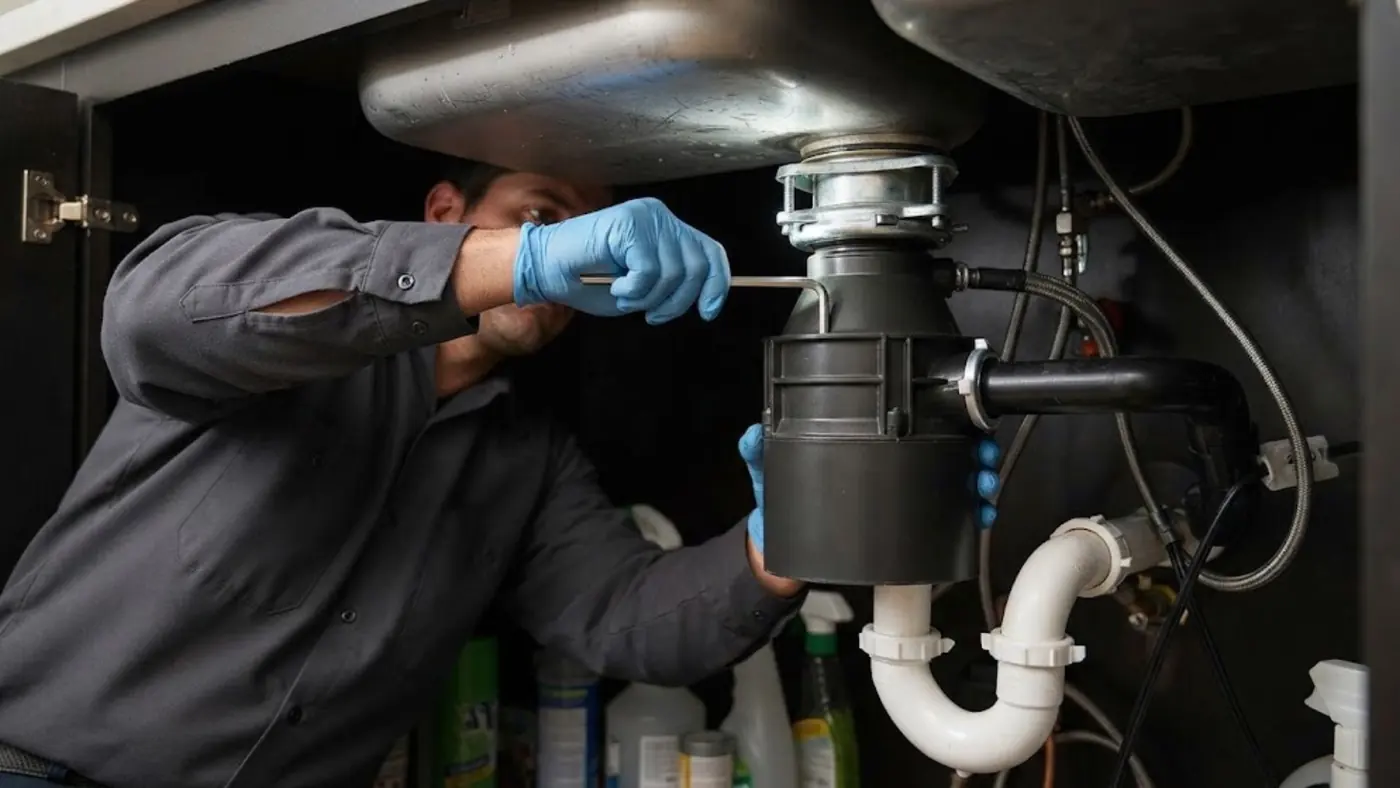
Mount the unit
Fit the mounting ring and hang the disposal from it.
Connect the drain and dishwasher
Reconnect the trap and knock out the dishwasher plug if there is a dishwasher.
Test
Run water and check for leaks and noise.
Many plumbers will tell you to check the dishwasher knock-out plug. If it stays in place, the dishwasher cannot drain and water backs up.
A single-bowl sink and a double-bowl sink have different trap layouts, and the installer should check which you have.
Choosing the right unit
What to consider
- Horsepower, with higher horsepower grinding tougher scraps.
- Feed type: continuous feed or batch.
- Noise insulation.
- Stainless components versus plastic ones.
- Septic compatibility if your home has a septic tank.
For most kitchens a continuous-feed unit of moderate horsepower is enough. A busy household that cooks daily does better with more power.
A disposal does not replace a trash can. Grease, fibrous peels and starchy foods still cause clogs, as our garbage disposal repair page explains.
Permits and licensing
New Jersey licenses master plumbers through the State Board of Examiners of Master Plumbers, and you can verify any plumber's license with the board. Electrical work needs a licensed electrician.
Permit rules vary by town. Ask the local building department whether a disposal install needs one, or ask us to confirm.
Disposals and sewer service in Pleasantville
Many properties connect to a municipal sewer, but some homes in the wider area use septic systems. Check with your municipality, because many septic systems do not suit heavy food waste.
A disposal adds solids to the line, so older cast iron drains may clog sooner. If your drains are old, ask us to run a camera and consider drain cleaning before adding load.
What it costs to hire a pro
The price depends on the unit, whether an outlet is needed and how complex the drain connection is. We quote after we see the sink and the cabinet.
Ask whether the price includes haul-away of the old unit and any needed parts.
Replacing a failed disposal
If the old unit used the same mounting ring, replacing it is straightforward. Disconnect the power, drain, and dishwasher hose, release the ring, and hang the new unit.
Many disposals use a standard mount, but older models may not. Check the ring and plan to replace it if it is cracked or corroded.
Questions to ask before you hire
Ask the installer
- Are you licensed, and what is the license number?
- Does the price include the electrical work?
- Will you check the dishwasher knock-out and drain?
- What does the warranty cover?
- Will you remove the old unit?
Signs of a bad install
A leak at the mount, a loose unit, a unit that vibrates or a drain that backs up after installation signals a bad install. Turn off the power and call the installer.
A properly installed disposal runs smoothly and leaves no moisture under the sink after a day of use.
Maintenance after installation
Run cold water while the disposal runs and for several seconds after. This flushes waste through the line and keeps grease from sticking.
Avoid putting fibrous or starchy foods in the unit, and clean it occasionally with ice and citrus peels or a manufacturer-approved cleaner.
Why a clean install matters
A disposal sits under the sink and shakes every time it runs. A loose mount causes leaks and noise, and a poorly sealed drain can drip into the cabinet.
Take time to check the gasket, the mounting ring and the drain connections after the first week. Tighten anything that has loosened.
Disposal alternatives
Some households skip the disposal and compost scraps instead. That keeps solids out of the line and reduces the chance of a clog.
If you rent or have older drains, composting may be a better choice. A disposal suits a household that wants the convenience and keeps grease out of the drain.
Planning around kitchen use
Tell the installer how you use the kitchen. A household that cooks heavily needs a different unit than one that eats out most nights.
Also mention any past clogs. A line that has clogged before may need cleaning before a disposal goes in.
Safety around a disposal
Never put your hand or a utensil in the unit, even when it is off. Switch off the breaker or unplug it before any work.
If something is stuck, use tongs or pliers and a hex wrench at the bottom to free the plate. Teach everyone in the house the same rule, including children and guests who may use the kitchen, so nobody reaches in while it is plugged in or running, and keep pets away from the sink.
Need a disposal installed or repaired? Call the 24/7 line.
Call (609) 547-1417Standards and sources
- Plumbing work in New Jersey is governed by the Uniform Construction Code plumbing subcode (N.J.A.C. 5:23-3.15), which adopts the National Standard Plumbing Code. Your local construction official issues permits and inspects the work.
- Plumbers are licensed by the New Jersey State Board of Examiners of Master Plumbers. You can check a license with the board before work starts.
- Electrical work for outlets, switches and circuits must be done by a licensed electrician.